
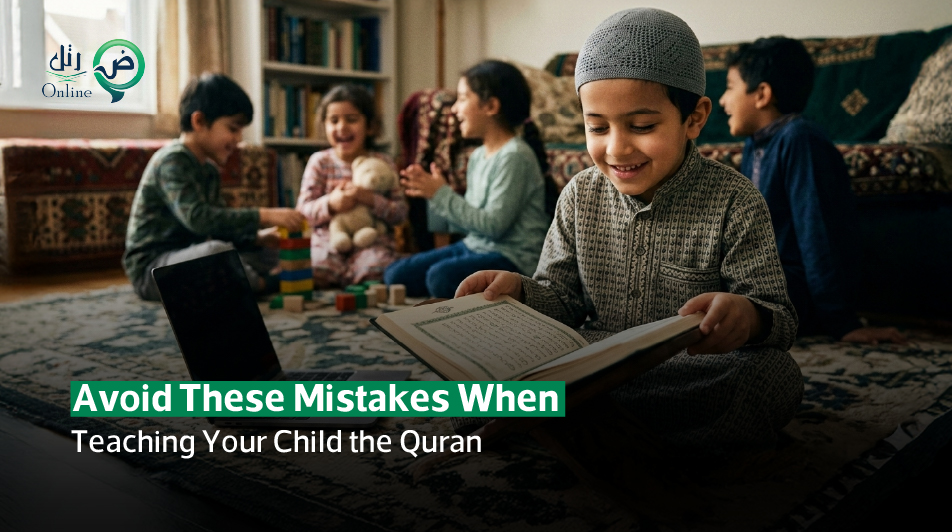
At the beginning, the intention is always pure.
We want to protect our children.
We want to connect them to the Qur’an.
We want them to grow up knowing their religion and their language.
But sometimes… with the best intentions… we make small mistakes that slowly turn into a big gap between the child and the Qur’an.
Not because the child doesn’t love the Qur’an…
But because the way we present it may not suit them.
So let’s honestly talk about the most common mistakes parents make when teaching Qur’an to children in non-Arab countries, and how we can gently fix them.
 Turning the Qur’an into pressure instead of connection
One of the most common mistakes is turning the Qur’an into a “heavy obligation.”
We often say things like:
- “Finish your homework, then start Qur’an.”
- “If you don’t memorize, you’re not going out.”
- “Why does your friend memorize more than you?”
Over time, the child doesn’t hate the Qur’an…
They associate it with pressure.
And a relationship that starts with pressure rarely turns into love.
 Comparing children to others
Comparison is very common in our cultures.
But when it comes to Qur’an memorization for kids, it can be very harmful.
Every child has:
- A different pace
- A different memory
- A different language background
A child growing up in an Arabic environment is not the same as a child living abroad speaking English all day.
Comparison doesn’t motivate… it creates frustration.
 Focusing on quantity instead of understanding
“How many pages did you memorize?”
This is one of the most common — yet least helpful — questions.
A child who memorizes one page and understands it
is better than a child who memorizes five pages without meaning.
Teaching Qur’an in a non-Arab environment should start with:
 Understanding
Meaning
Real-life connection
Because Arabic is not always their first language.
 Choosing the wrong teacher for your child
Not every Qur’an teacher is suitable for children.
Children need:
- Patience
- Warm communication
- Interactive teaching
- Cultural awareness
Especially in online Qur’an learning, the teacher only has their voice and method.
If the approach is not engaging, the child quickly loses interest.
 Ignoring weak Arabic skills
Many parents expect their child to read fluently,
while their Arabic is actually limited.
In reality, many Arab children living abroad:
- Struggle to understand Arabic
- Feel shy speaking it
- Rarely use it outside the home
When they are asked to memorize immediately, they feel overwhelmed.
And that feeling often leads to resistance.
 Making the session longer than the child’s capacity
A 6 or 7-year-old child cannot focus for 40 minutes straight.
Yet sometimes, we treat Qur’an sessions like university lectures.
The truth is:
15 focused minutes are better than 45 distracted ones.
Especially in learning Arabic or Qur’an online.
 Lack of a consistent routine
One day it’s Monday.
Another day it’s Thursday.
Sometimes after Maghrib… sometimes before bed.
Children need consistency to feel secure.
Without a routine, Qur’an becomes an occasional task…
not a natural part of their life.
 Constant interruption during recitation
Out of care, many parents sit next to their child and keep correcting:
“No, read it like this.”
“Focus.”
“Repeat it.”
This makes the child feel monitored… not supported.
Your presence matters — but it should feel encouraging, not evaluative.
 Expecting quick results
We often want to see progress within a month.
But building a child’s relationship with the Qur’an takes time.
The goal is not speed…
The goal is consistency.
And consistency always wins.
 Forgetting that the Qur’an is a relationship, not a project
The biggest hidden mistake is treating the Qur’an like a “task.”
But in reality, it is:
- A relationship
- A feeling
- A connection
If the child doesn’t feel comfortable while learning…
They won’t stay.
So what’s the solution?
The answer is not more pressure.
And not blaming ourselves.
The solution is redesigning the entire learning experience.
This is where choosing the right environment makes all the difference.
How does Ratel School avoid these mistakes?
At Ratel Qur’an School, the philosophy is different:
 1:1 personalized sessions — no comparison, no pressure
Teachers trained to work with children living abroad
Arabic level is considered before memorization
Sessions designed based on age and attention span
Focus on understanding before quantity
Consistent routine that fits the family’s lifestyle
The goal is not to produce a “fast memorizer,”
but to raise a child who feels connected to the Qur’an with confidence and peace.
In the end…
We all make mistakes — with good intentions.
But awareness is the first step to change.
If you feel your child is starting to drift away,
it doesn’t mean you failed.
Maybe all you need is to adjust the method… not the goal.
 And if you’re looking for a learning experience that avoids these mistakes from the start,
a free trial session with Ratel School might be the first step in the right direction.
 Book your child’s free trial session now and help them build a calm, lasting relationship with the Qur’an.