
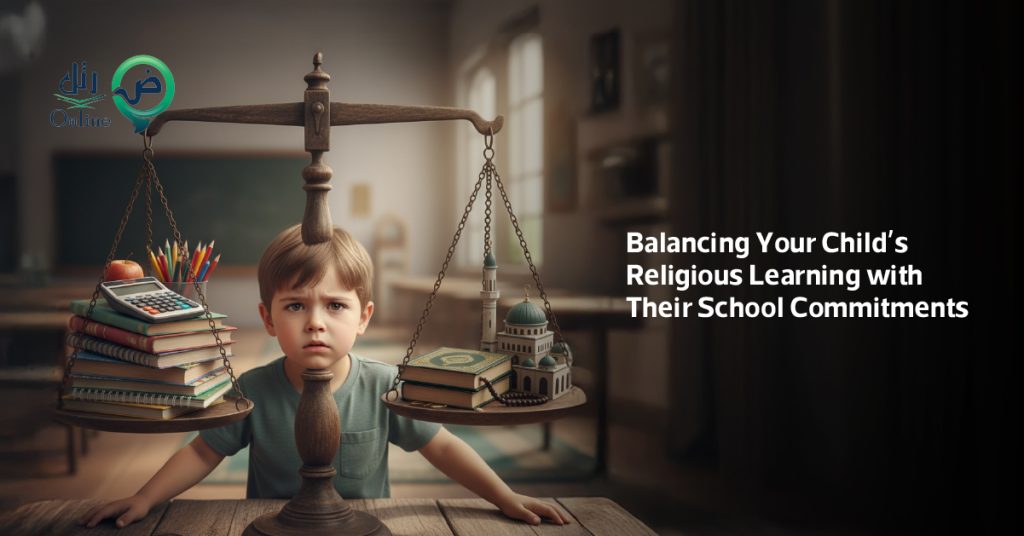
Should I sacrifice my son’s academic success so he can get closer to Allah and learn more about his religion?
This question may cross your mind when you see your child exhausted after a long day at school, and you feel a genuine desire for them to make time to learn about their religion and grow closer to it.
You try hard to balance both worlds. But let’s be honest, things rarely go as you plan. The scale always tips to one side.
Lots of parents fall into this daily struggle, feeling like they’re forced to choose between two things that are both important for their kids’ future.
That’s exactly why we wrote this article – to share practical, simple tips you can start applying today. Tips that will help your child succeed in both school and religion, without having to sacrifice one for the other.
If your child focuses only on school: He might get high grades, but he’ll feel a deep spiritual emptiness in his relationship with Allah. Maybe he drifts away from his Islamic identity bit by bit, and when life gets tough on him, he won’t find solid values to lean on.
But if your child focuses only on religion: He might miss getting into good universities or job opportunities that guarantee him a decent life in the future.
Before we go on, let’s stop at an important meaning of worship that might escape some people’s minds.
When you hear the word “worship,” maybe prayer, fasting, and reading Quran come to mind. You don’t usually think of studying, attending classes, or taking exams as worship.
But what if we told you that studying can be worship too? That school and religion don’t have to fight against each other? They can actually work together in complete harmony.
Now that we’ve cleared this up, it’s time to learn some tips that will help your child balance worldly and religious learning easily.
No matter how many of the previous tips you apply, no matter how many plans and programs you set up, if you yourself aren’t the living role model in front of your child, everything will go down the drain.
Your child watches you every moment. When he sees you pray on time despite being busy, read Quran even on the hardest days, remember Allah while living your life – that’s when he’ll understand this is the normal lifestyle.
Finally, don’t forget that dua is your strongest weapon in this journey. Always ask Allah to guide your child, protect him, and grant him success in his religion and worldly life.
We’re Here to Help You
We know it might seem exhausting. Trying to find time for both studying and religion isn’t easy, especially if you have lots of responsibilities.
That’s why at Rattel School, we offer you the practical solution to this challenge.
We offer you three programs that fit with your child’s daily routine, where he learns Quran, Arabic, and Islamic knowledge in a fun way suitable for his age with specialized teachers who graduated from Al-Azhar.
We give you a chance to attend two free sessions to test for yourself Rattel School’s impact in supporting your child’s religious and educational development.
Start today and book two free sessions from the link below:
Subscribe now to the Ratal Online School mailing list and you will receive weekly tips and best practices to help you teach your children the Quran and Arabic language.
All rights reserved © 7930771 Rattiel LLC
Gold Ave Sw Pmb 601, Albuquerque, NM 87102