
I want my child closer to Allah. I want him to be connected to his Islamic identity.
I want to protect him from everything around him pulling him away.
I want him proud of who he is – an Arab Muslim.
I want the Quran to shape his character, just like it did for Prophet Muhammad (peace be upon him).
Whatever your goal is, the path starts in one place:
Teaching him Arabic.
But here’s what we need to figure out: How do we make our kids understand why this language matters? How do we get them actually excited to learn it? Is there a way to turn this from a burden into something they actually want to do?
Let’s figure this out together.
Before we jump into methods and techniques, let me ask you something real quick:
Have you ever asked yourself why kids prefer playing over studying?
1️⃣ Playing gives them instant joy. They feel good right now, not later. Studying asks them to wait forever before seeing any results.
2️⃣ Playing lets them be free. Move around, explore, go anywhere. Studying locks them in one spot, makes them sit still and focus non-stop.
3️⃣ Playing satisfies their curiosity super fast. They try something and see what happens in seconds. Learning results show up painfully slow – sometimes days or weeks or even months later.
4️⃣ While playing, kids try stuff, mess up, and try again without worrying about getting in trouble. When studying, every mistake makes them feel like they failed, every correction makes them feel less smart.
If you want to make learning the language of the Quran fun for your kid, all you got to do is make learning feel more like playing. Yeah, it’s that simple as an idea. Takes some creativity and effort to pull off though.
✅ Turn the lesson into an adventure
Instead of saying “today we’re learning the letter ب,” tell him “today we’re going on an exciting hunt to find the hidden letter ب treasure around the house.”
Make him the brave explorer looking for the letter in things around him: door (bab), watermelon (batikh), blanket (battaniya). Every time he finds one, he gets a point. After that, you introduce the letter to him properly.
This tiny change in how you present the lesson makes him feel like he’s in a game.
✅ Use rewards and points
Kids love winning. They love accomplishing things. They want to see their progress with their own eyes.
Put a colorful board on the wall or use an app to track your kid’s points. Every letter he learns gets him points. When he collects enough points, he gets a reward.
✅ Make up stories together
Sit with your child and create a story together in Arabic. You start with a sentence, he continues with another one.
Don’t stress about mistakes at first. This isn’t an exam. What matters is he feels totally free to say what’s on his mind in Arabic, even if he makes a bunch of grammar errors. Later you can write the story together on paper the right way, without mistakes.
✅ Play pretend with him
Kids naturally love acting. Make a small play at home in Arabic. Could be a story he likes, or a story he makes up himself. Let him choose which character he wants to play. This fun approach helps him remember words and sentences naturally, without feeling like he’s studying.
✅ Use songs and beats
Kids memorize songs so fast. Why not use this amazing skill to teach them the language?
Songs and rhythm make memorization incredibly easier. Search for nice educational songs in Arabic or make your own song with your kid for the letters or new words he’s learning.
✅ Use technology the right way
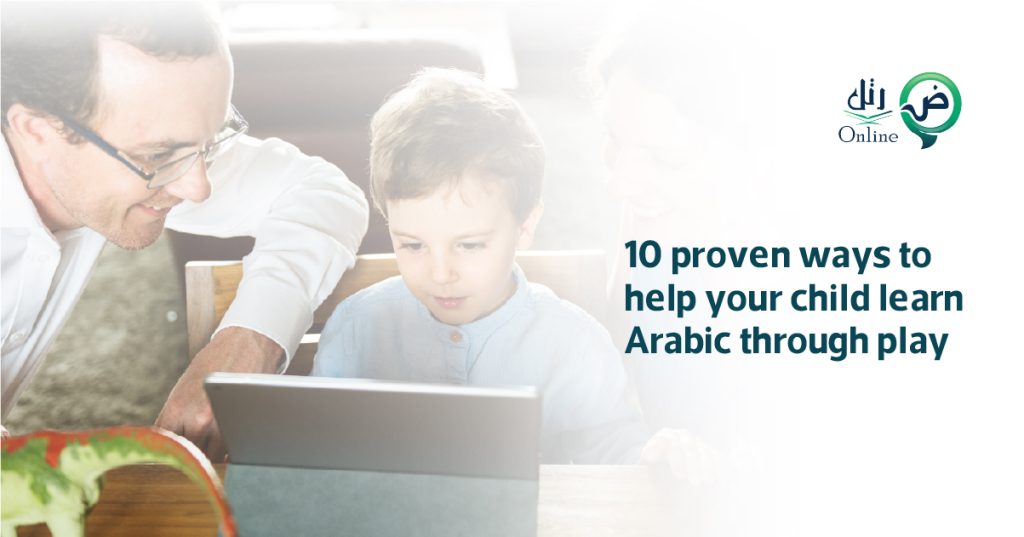
Use apps and educational games made specifically to teach Arabic in a fun, interactive way. But watch out – don’t leave your kid alone in front of a screen for hours. Play with him. Sit next to him. Discuss what he’s learning. Ask him what he understood.
✅ Connect the language to everyday life
Don’t keep Arabic limited to lesson time only. That’s a big mistake a lot of people make. Use it in daily life as much as you can. Ask him to tell you in Arabic what he wants for breakfast, or tell you about his school day in simple sentences, or count the stairs with you while going up.
✅ Celebrate mistakes as part of learning
Don’t correct every mistake in a way that makes him feel frustrated or like he failed. Instead, tell him “good job, great try, let’s try this another way together.” Make it super clear to him that mistakes are a normal part of learning, not something he should be embarrassed about or scared of. This creates a safe space mentally for trying and growing – a space where he feels free to try without fear.
✅ Keep study sessions short
Kids can’t focus for long stretches. Instead of one exhausting two-hour study session once a week, split that time across four days – 15 to 20 minutes each time.
✅ Read with him every day
Pick beautiful picture books in Arabic and read them with your child before bed or any quiet time during the day. Let him point at the colorful pictures. Let him try reading some simple words himself. Let him ask you about words he doesn’t get. Reading together doesn’t just build love for the language – it strengthens your emotional connection at the same time.
At the end of the day, let me tell you something. You could apply everything experts recommend to the letter. Put in huge effort and a lot of time. And still not see the results you’re hoping for.
Because sometimes all your child needs is an outside source. Someone he doesn’t know from outside the house.
Because the relationship with a teacher is completely different from the relationship with mom or dad. With a teacher, your child’s commitment is way higher. Also, the teacher comes with specialized experience and teaching tools designed specifically for this purpose – tools you might not have. Plus, having a real teacher creates a kind of seriousness and discipline that can be hard to achieve at home with all the never-ending daily life responsibilities.
This doesn’t mean at all that your role isn’t important or secondary. Your role stays essential and necessary in daily follow-up, constant encouragement, and living the language at home.
And this is exactly what you’ll find for your child with Rattel School teachers. They combine deep teaching experience with real understanding of the needs of Muslim kids living abroad, to create a learning experience that’s fun and effective at the same time – an experience that makes your big dream come true of bringing your child closer to the language of the Quran and his Islamic identity.
Start today and book two free sessions for your child from the link below:
Subscribe now to the Ratal Online School mailing list and you will receive weekly tips and best practices to help you teach your children the Quran and Arabic language.
All rights reserved © 7930771 Rattiel LLC
Gold Ave Sw Pmb 601, Albuquerque, NM 87102