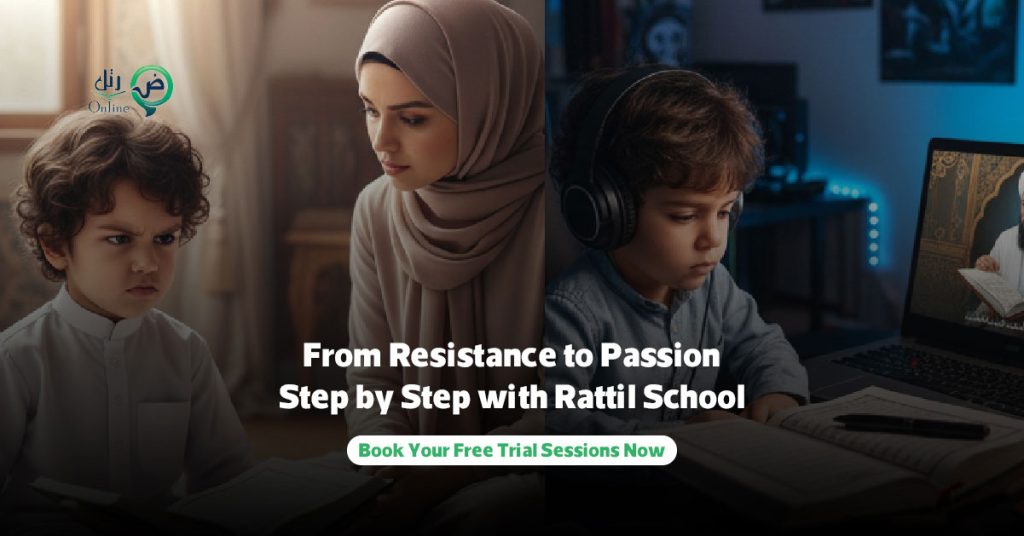
Imagine this scene…
You’re sitting in front of your laptop, your child beside you, excitedly trying to begin their very first lesson in the Qur’an or the Arabic language.
Then suddenly, you see that look you know so well: boredom, resistance, or you hear the phrase, “I don’t want to learn.”
A thought crosses your mind:
Maybe online learning just doesn’t suit them?
But the truth is—it’s not that simple.
At Rattil School, we’ve seen dozens of children who started out with the very same resistance… and ended up developing genuine love and passion for learning.
So why do children resist learning the Qur’an or Arabic online?
And how can we turn resistance into motivation?
Let’s explore the real reasons—and the proven solutions—step by step.
First: Why do children resist online learning?
A child’s refusal to learn the Qur’an or Arabic online isn’t merely a personal issue. It’s often the result of a combination of biological, psychological, and environmental factors. Understanding these causes is the first step toward transforming resistance into enthusiasm.
1. Digital Fatigue
Today’s child already spends long hours between school, homework, and screens. After an exhausting day in front of computers or tablets, asking a child to sit through an online Qur’an lesson can feel overwhelming. This isn’t laziness—it’s a natural biological need for movement and rest.
2. Lack of a Clear Purpose (“Why am I learning this?”)
Children live between two worlds: the school world, where everything is shared and socially reinforced, and the home world, where they’re asked to learn things like Arabic or the Qur’an. If a child doesn’t understand why they’re learning, their motivation naturally declines.
3. Teaching Methods That Don’t Match Children
Some traditional memorization methods may work in physical classrooms but don’t align with the mindset of children raised on short videos and interactive games. Dry lessons and rote instruction can quickly drain their enthusiasm.
4. Language Shyness and Constant Comparison
An Arab child living abroad may feel embarrassed speaking Arabic in front of peers or teachers—especially if they aren’t surrounded by other Arabic-speaking children. Comparisons with friends who don’t study Arabic can also negatively affect motivation.
5. Poor Timing and an Unsuitable Home Environment
Incorrect lesson timing (after a long school day or before a favorite activity) or a home full of distractions makes true focus nearly impossible.
How do we turn resistance into desire?
Before diving into practical solutions, here are general principles that have proven successful with thousands of children:
- Listen before you instruct: Let the child hear and enjoy first. Connecting the Qur’an to emotion creates desire before obligation.
- Small, repeated success beats rare, heavy pressure: Tiny steps and simple rewards build lasting habits.
- Learning must feel meaningful: Linking memorization to understanding and daily application gives it real value.
- Respect the child’s pace: Individual differences are real—never compare your child to others.
-
Practical, proven solutions to common challenges
1. “My child is bored—what should I do?”
- Lesson length: For young children, 10–15 minutes is far better than 30 minutes of ineffective effort.
- Add play: Use cards, mini-competitions, or interactive audio apps.
- Change the setting: Sometimes sitting in a new corner of the house or reading on a comfy cushion makes all the difference.
-
2. “My child feels shy or afraid of making mistakes”
- Start with a safe 1:1 environment: One-on-one lessons reduce embarrassment and build confidence.
- A supportive teacher matters more than a perfect reciter: Choose teachers with educational skills—encouragement, patience, and praise.
- Normalize mistakes: Teach your child that mistakes are part of learning, and that the teacher is there to help, not judge.
-
3. “My child loses focus quickly”
- Break lessons into short segments: 5 minutes of learning + 2 minutes of movement or play.
- Use visual aids: Word cards, simple illustrations explaining verse meanings.
- Set a fixed time: Routine builds expectation and commitment.
-
- 4. “My child doesn’t see the value of learning (Why am I different?)”
- Explain the benefits in simple terms: Reading Qur’an in prayer, speaking Arabic with family, understanding the stories of the Prophets.
- Link learning to interests: If your child loves football, teach Arabic through sports-related stories or vocabulary.
- Let them share achievements: Reciting a verse in front of family or recording a short recitation boosts pride.
-
- 5. “The timing just isn’t right”
- Choose the best time based on your child’s energy: Some children perform best in the morning, others after a nap.
- Avoid clashes with favorite activities: Don’t schedule lessons during playtime with friends or a beloved TV show.
-
How Rattil School customizes solutions for each child
At Rattil School, we believe there is no one-size-fits-all solution. That’s why we follow a flexible, child-centered model based on:
- One-on-one lessons (1:1): Allow teachers to adapt tone, pace, and interaction style.
- Educationally trained teachers: Al-Azhar graduates and Qur’an memorizers who are also trained in modern child communication techniques.
- Time and language flexibility: Lessons scheduled to suit families abroad, with teachers who speak English or other languages to bridge understanding for children whose daily language isn’t Arabic.
- Results, not quick promises: Our approach is built on measurable daily progress—because consistent small steps are better than irregular big efforts.
At Rattil School, our goal is to transform a child’s resistance to learning the Qur’an or Arabic online into lasting love and passion. We believe every child deserves a teacher who understands them, a curriculum that suits them, and a supportive environment that helps them grow.
 Would you like to try a free trial lesson with one of our teachers to see how we address your child’s resistance step by step?
Book now, and we’ll create a personalized plan tailored to your child’s age and needs.