
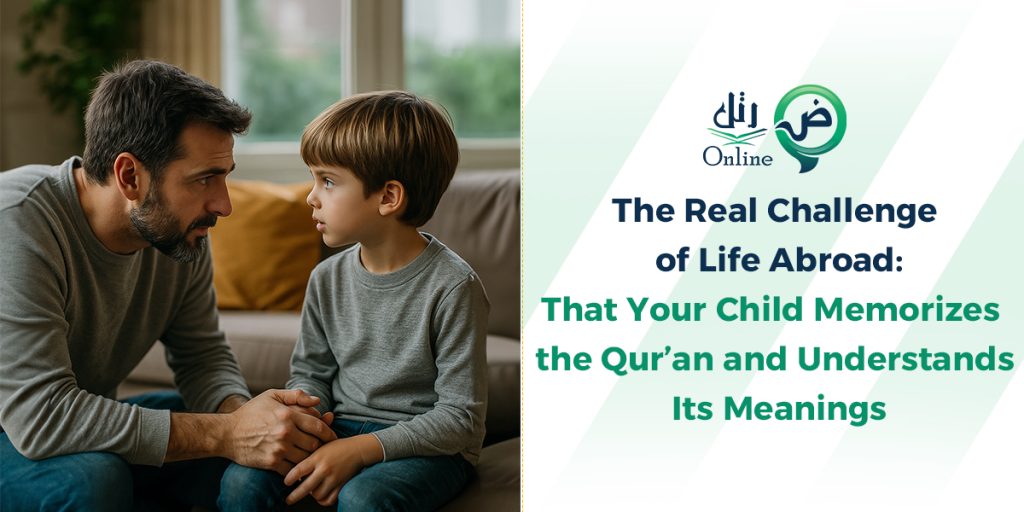
From a young age, we grew up hearing the verses of the Holy Qur’an in our homes, then memorizing it in our schools, until it became a source of pride and joy in family gatherings.
My father would proudly say in front of my uncles, “My son has memorized Surah Al-Fatihah and Al-Ikhlas,” and my mother, among her sisters, would proudly compete: “My child memorized Juz’ ‘Amma in record time.”
Memorizing the Qur’an was not merely an achievement we celebrated—it was a sign of a righteous home and a symbol of proper upbringing.
As we grew older, our minds matured and our perspective of the Qur’an deepened. We came to realize that it is not merely words to be memorized or recited, but a spirit that revives hearts, a way of life, a divine constitution, and a light for all humanity—guiding us through the darkness of worldly life and by which Allah keeps believers firm upon the truth in every time and place.
Time passed, and whenever we drifted away from the Qur’an, we found ourselves returning with greater awareness. We recall the words of the Prophet ﷺ regarding the status of the one who memorizes the Qur’an:
“The example of the one who recites the Qur’an and memorizes it is that he is with the noble, righteous scribes. And the example of the one who recites it and struggles with it while it is difficult for him, he will have two rewards.”
(Narrated by Al-Bukhari from ‘Aishah, may Allah be pleased with her)
And he ﷺ also said:
“The best of you are those who learn the Qur’an and teach it.” (Narrated by Al-Bukhari)
From here, we truly feel that goodness begins—through our genuine connection with this great Book.
Now comes our turn to pass on to our children the love for the Qur’an we were raised upon. Yet the challenge lies in the fact that they are growing up in Western countries, far removed from the Arabic environment we knew. Every era has its own context, and every generation its own characteristics. Naturally, a recurring question arises in your mind:
What is the right path to give my children a correct beginning?
Surely, you do not want your children to merely repeat verses they do not understand, especially amid differing cultures and surrounding languages.
So let us think more deeply:
How can we help them understand the Qur’an, love it, and connect with it—without feeling bored by memorization sessions—while following an approach that suits their age and level of comprehension?
This leads us to a crucial question that has made a difference for many parents:
Should children learn Arabic first?
Or should we begin memorizing the Qur’an even if they have not yet mastered the language?
To answer this, we must first understand the appropriate age to begin learning the Qur’an or the Arabic language. Experts and educators agree that early childhood years are years of planting and nurturing—the golden stage in a child’s life for language acquisition, skill development, vocabulary building, and interaction with the surrounding environment.
At this stage, a child’s mind is more receptive, their memory more flexible, and their ability to absorb far greater than in later stages.
What follows are the years of harvest—reaping the fruits of what was planted: love for the language and familiarity with the Qur’an—while continuously refining and guiding this growth with gentleness and consistency.
Here, the importance of the Arabic language in understanding the Qur’an becomes clear. Arabic is the foundation upon which a child’s comprehension of the Qur’an is built. If the early stage is the golden period for building a strong linguistic foundation, then that foundation becomes the key to understanding verse meanings, engaging with Qur’anic stories, and implementing divine commands.
The Qur’an was revealed in clear Arabic, and its depth cannot truly be accessed without understanding the language in which it was revealed. The more firmly Arabic is rooted in a child’s mind, the stronger their interaction and connection with the Qur’an becomes—moving beyond mere memorization and rote learning toward reflection, engagement, and action. This represents the view of the first group among the righteous predecessors.
The second view is summarized by the words of Ibn Khaldun رحمه الله:
“The Qur’an became the foundation of education upon which all later skills are built. This is because learning in childhood is more firmly rooted, and it becomes the foundation for what follows—since the first thing that enters the heart is like the foundation of all abilities.”
This view suggests that memorizing the Qur’an at a young age becomes deeply ingrained in memory, even if the child does not yet understand its meanings. Early memorization forms a strong base upon which linguistic and cognitive skills are later built, paving the way for understanding and reflection at a more advanced age.
You may now feel even more uncertain about which path to choose. This is precisely why there is a pressing need for a flexible methodology—one that balances memorization with understanding, and achieves the ultimate goal: connecting the child to the words of Allah while strengthening their Arabic language, in a way that suits life in a non-Arabic-speaking society.
The earlier you begin with your child, using an approach that suits their mind and soul, the more firmly love for the Qur’an will be rooted within them—becoming their ultimate reference in life.
Teaching Arabic and helping children memorize the Qur’an—through the right method, the right teacher, and a supportive environment—are not secondary details. They are essential foundations for a sound beginning and for building the Qur’anic future we aspire to for our children.
Subscribe now to the Ratal Online School mailing list and you will receive weekly tips and best practices to help you teach your children the Quran and Arabic language.
All rights reserved © 7930771 Rattiel LLC
Gold Ave Sw Pmb 601, Albuquerque, NM 87102