
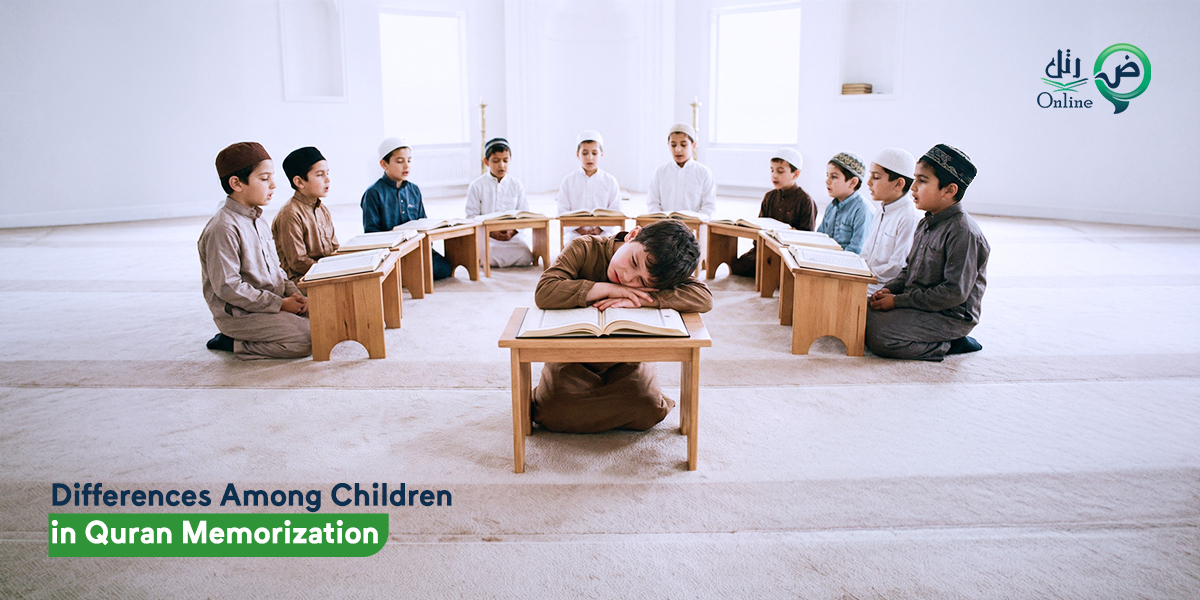
At the same age.. And sometimes even in the same class
You may see one child memorizing quickly, reciting confidently, and always asking for more.
And another child…
Hesitates, forgets quickly, and needs much more time.
This is when a question quietly forms in many parents’ minds: “Is my child slow?”
But the truth is very different.
Progress in Qur’an Learning Is Not a Measure of Intelligence
This is the first thing we need to truly understand:
Fast memorization does not automatically mean intelligence.
And slow progress does not mean weakness.
The real difference between children is not only their abilities…
It often comes down to many other factors.
 Daily Environment
A child who hears Arabic every day,
And regularly sees people around them reading Qur’an,
Often progresses more naturally.
But a child growing up abroad may experience Arabic as a “new subject” rather than a living language.
And this creates a major difference in Qur’an memorization for children.
For many children in non-Arab countries, Qur’an learning is not just memorization…
It is also cultural and linguistic adaptation.
 Language Before Memorization
Many children are not actually struggling with memorization itself…
They are struggling with understanding.
A child who does not understand the words
Will often memorize with more difficulty…
And forget more quickly.
This is why in teaching Qur’an to children abroad,
Language is not a small detail…
It is a foundation.
When understanding improves, memorization often becomes easier and more meaningful.
 The Type of Teacher
A teacher can either make the journey…
Or unintentionally make it harder.
A teacher who is:
- Patient
- Interactive
- Child-aware
Can make the session feel smooth and encouraging.
But a teacher who depends only on repetition and traditional instruction
May cause the child to lose interest.
Not every qualified Qur’an teacher is automatically the right fit for every child.
Especially in online learning,
The teacher’s style often makes all the difference.
 Learning Style
Not every child learns the same way.
Some children are:
- Auditory learners
- Visual learners
- Repetition-based learners
- Movement-based learners
When one single method is used for every child,
Differences naturally become more obvious.
A child who needs visual support may struggle in a purely verbal class.
A child who needs repetition may feel rushed.
This is why personalized learning matters.
 Pressure vs. Comfort
A child learning under constant pressure:
“Memorize faster.”
“Why are you behind?”
“Hurry up.”
Often struggles more.
Pressure creates fear…
And fear slows progress.
But a child who feels safe when you say:
“Take your time.”
“You’re improving.”
“Let’s keep going.”
Usually progresses more steadily.
In Qur’an learning, emotional safety is often more powerful than urgency.
 Revision
One of the biggest reasons children struggle is not memorization itself…
It’s forgetting.
Without a consistent review system:
- The child feels they keep forgetting
- Confidence decreases
- Motivation drops
- Progress slows
Memorization without revision can feel frustrating.
This is why structured review is just as important as new memorization.
 Individual Differences
Some children:
- Memorize quickly
- Others retain more deeply
- Some need more repetition
- Others need stronger understanding first
And this is normal. The real goal is not speed…It is consistency.
A child who progresses slowly but steadily
May ultimately build a stronger and more lasting relationship with the Qur’an.
How Does Rattiel Handle These Differences?
At Rattiel Qur’an School, there is no unhealthy comparison.
Because every child is different.
 Each child has a personalized plan
Memorization pace matches their ability
Language support is provided when needed
Continuous revision is built in
The teacher is matched to the child’s personality and needs
Because the goal is not: “Who memorizes faster?”
The goal is: “Who continues… and loves the Qur’an?”
In the End…
If your child progresses more slowly…That does not mean they are weak.
They may simply need:
- A different method
- A different teacher
- More language support
- Or simply… more time
In the right environment, Every child can progress in Qur’an learning in their own way.