
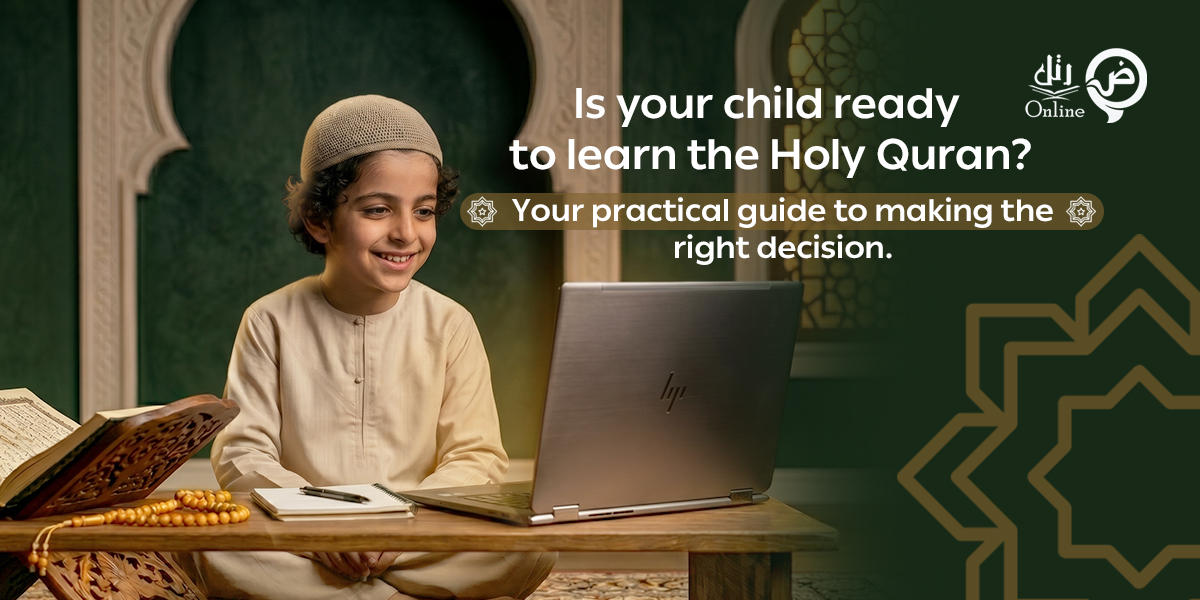
A Practical Guide to Making the Right Decision
In many households, especially in expatriate communities, this question frequently arises: Should I start teaching my child the Quran and Arabic now? Or is it still too early?
This question is not solely tied to chronological age but rather to the child’s psychological and mental readiness.
Indeed, knowing the opportune moment can make a significant difference in a child’s journey with the Book of Allah and its Arabic language.
In this article, we will provide you with a clear guide, built upon modern educational principles, to help you understand when a child is ready to learn, what signs indicate this readiness, and how to prepare them for a successful start.
First: What is the Appropriate Age to Begin Learning?
Educational studies indicate that early childhood is the most suitable stage for language acquisition, as the brain at this stage is characterized by a high capacity for learning and imitation.
According to recent educational research, the age range of 4 to 6 years is considered the “golden age” for systematic learning, where a 5-year-old child can absorb between 2000 to 2500 new words annually.
However, more important than age are the signs of individual readiness, rather than merely reaching a certain age.
Second: How Do You Know Your Child is Ready?
There are four basic, easily observable signs that indicate a child’s maturity for remote learning:
- Ability to focus for a short period: If a child can sit for 10 to 15 minutes on a single activity, such as listening to a story or an educational game, this indicates their readiness for online learning.
- Love of imitation: Learning the Quran initially relies on listening and repetition. If your child tries to imitate what they hear or repeats words and phrases after you, this is a strong sign of their readiness.
- Curiosity and desire to understand: Asking simple questions like “What does this word mean?” indicates that the child has begun to care about understanding, not just listening, which is a fundamental driver for learning.
- Interaction with digital communication: If the child can communicate with others via video calls without excessive shyness, it means that the screen barrier will not hinder their learning.
Third: Why is Online Learning an Ideal Option Abroad?
Children outside Arab countries face the challenge of “language duality.” Here, online learning offers strategic advantages:
- Flexibility and continuity: Choosing times that suit a busy family schedule.
- Psychological comfort: Learning from home reduces stress and makes the child more open to the teacher.
- Individual focus: Educational reports indicate that individual (1:1) learning increases comprehension speed by up to 60% compared to group classes.
Fourth: How to Prepare Your Child for a Successful Start?
To ensure a positive experience, we recommend following these steps:
- Psychological preparation: Talk to the child about learning positively, making them feel it’s an enjoyable experience, not a heavy duty.
- Prepare a suitable place: Choosing a quiet and comfortable corner helps the child focus and connect with the lesson.
- Participation and encouragement: It is preferable for one parent to sit with the child during the first lessons to make them feel secure, while being keen to reward them for small achievements.
Fifth: When is it Better to Postpone the Start?
In some cases, it may be better to postpone the start slightly to ensure that a negative relationship with learning is not built. This is if the child completely refuses to learn, cannot focus even for a very short period, or suffers from significant distraction. In this case, starting with gradual preparation through listening only is better than direct pressure.
Sixth: How Can Rattiel One Academy Support You?
At Rattiel One Online Academy, we fully understand these individual differences, and therefore, we have designed a learning environment that caters to your child’s needs through:
- Specialized teachers: Graduates of Al-Azhar Al-Sharif who combine knowledge with modern educational methods.
- Overcoming the language barrier: Our teachers speak your child’s primary language (English, German, French, Spanish, Italian) to facilitate communication and build trust.
- Interactive methodology: We use educational methods that increase a child’s focus and make them eagerly anticipate lesson time.
Conclusion
The decision does not depend solely on the child’s age, but on their readiness and ability to interact.
When the appropriate signs are present, an early start with the right approach leaves an indelible mark on the child’s life and identity.
Do you want to confirm your child’s readiness? Book two free trial sessions now at Rattiel One Academy, and let us help you assess your child’s level and discover the most suitable way to teach them.