
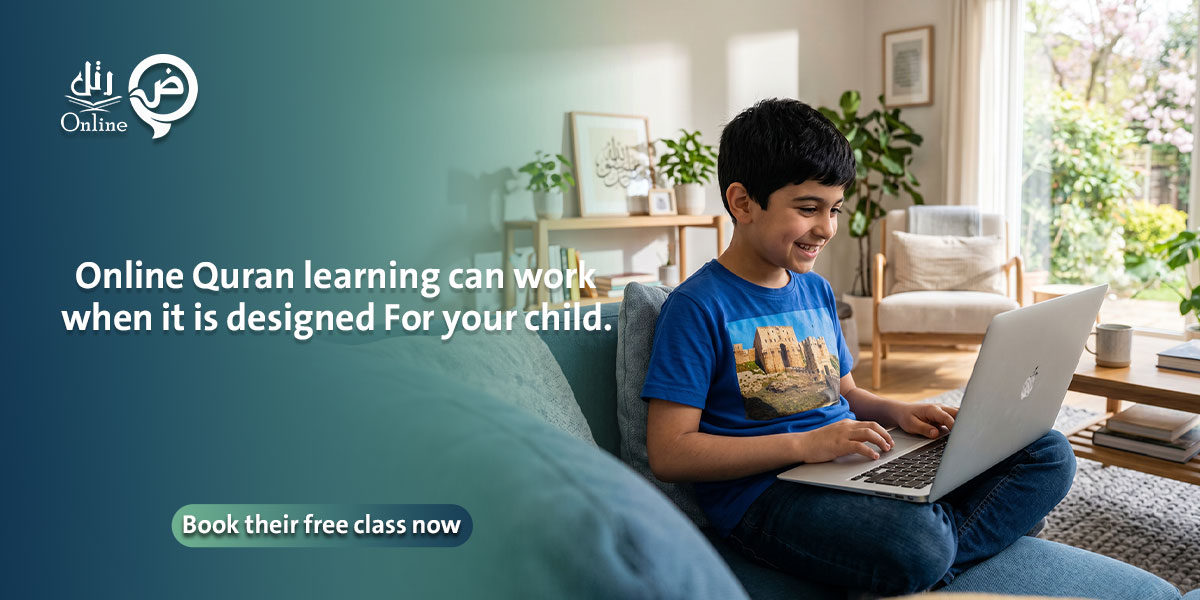
The first time you think about enrolling your child in an online Quran class, hesitation naturally begins.
Is my child too young?
Will they understand through a screen? Will they even sit still?
Is this truly beneficial, or is it simply an experience that does not suit their age?
These questions are not a sign of weakness. They are proof that you are trying to make the right decision. But before we judge the idea, let us look at it from a different angle:
the truth is, the world has changed and we may not have fully noticed.
Children today do not live in the same world
we grew up in.
They interact with screens, videos, and interactive games every day, naturally and comfortably.
A child does not see a laptop as “distance learning.” They see it as a way to communicate. So, the problem is not “online learning” itself.
The real question is: how is it presented to the child?
The Problem Is Not Online Learning… It Is the Method !!
Many unsuccessful experiences with online Quran learning for children did not fail because of the idea itself.
They failed because of the way it was delivered.
If a child sits in front of a screen while a teacher recites and the child simply repeats, with no interaction, no understanding, and no emotional connection, then any child will lose interest.
Not because they are too young, but because the experience is not designed for them.
Let us look at the class through the child’s eyes.
If the class is long, full of corrections, lacking interaction, and missing a human connection, the child will reject it whether it is online or in person.
But if the class is short, interactive, encouraging, light, and simple, the child can enjoy it, even through a screen.
What About Children Living Abroad?
Here, the situation changes completely. Arab children living abroad do not usually learn the Quran in an environment that naturally supports it.
In their everyday life, the child may speak a language other than Arabic, study curricula that are far from religion, and live in a society where the Quran has little or no visible presence.
There is no azaan they hear regularly, no friends memorizing the Quran with them, and no space where they feel that what they are learning is normal.
And this is where the real challenge begins.
The Child Does Not Reject the Quran… They Simply Do Not Find a Place for It
For children living abroad, the Quran is not necessarily something they reject.
Rather, it often feels “absent” from their daily life.
And that is a very important difference.
When a child does not see something in their everyday world, they do not necessarily refuse it they simply forget it.
Quran learning then becomes a separate activity, an extra effort, and something they may not understand the reason behind.
This is when distance begins to grow, quietly and gradually, without us realizing it.
Online Learning Then Becomes Not Just an Option… But a Necessity
In this situation, online Quran learning is no longer a luxury.
It becomes one of the most important solutions.
Because the child needs to hear Arabic, see a teacher who understands them, and feel that learning the Quran is something normal and close to them.
When designed correctly, online learning can help fill this gap.
But Not Every Online Experience Works
This is the key point:
not every online Quran class is suitable for a child living abroad.
Because the child does not simply need a “lesson.” They need an environment.
An environment that understands their weak Arabic, does not pressure them, builds a relationship before focusing on memorization, and helps them feel safe.
If this is missing, online learning becomes a burden.
A Child Does Not Need Memorization First… They Need Connection
One of the biggest mistakes is starting with memorization immediately.
A young child first needs to listen, get used to the sound, and feel that the Quran is easy, close, and comforting.
Memorization can come later, naturally and gradually.
How Do We Know If Online Learning Is Suitable for Our Child?
Online Quran learning can be suitable when:
✔️ The class is short and appropriate for the child’s age
✔️ There is real interaction
✔️ The teacher understands children
✔️ There is no pressure or comparison
✔️ The child feels comfortable
But if these elements are missing, then the problem is not online learning itself.
The problem is the experience.
And this is where the real difference appears.
At Rattiel School
At Rattiel School, Quran education was not simply moved online.
The entire learning experience was redesigned around the child.
✔️ One-to-one lessons
✔️ Teachers who understand children living abroad
✔️ Attention to language before memorization
✔️ Short and interactive sessions
✔️ Building connection before teaching
Here, the child does not feel like they are “in a lesson.”
They feel they are in a space where they are understood.
In the End…
Online Quran learning for young children is neither a problem nor a magical solution.
It is a tool. If used in a traditional way, it will fail.
But if it is designed around the child, it can succeed.
And if you are not sure whether it is suitable for your child or not, the best way to know is not by overthinking it but by trying it.
Book a free trial class for your child with Ratel School, and let them discover for themselves how learning can be simple, comfortable, and close to their heart.