
The journey began with excitement
A regular lesson schedule, a new Surah to memorize, time to review previous lessons, and your child making steady progress in learning the Quran.
At first, everything seemed to be going perfectly But after a while, you started noticing something different.
Your child now needs more time to memorize the same number of verses. A Surah they memorized just a few weeks ago is becoming harder to remember. Or perhaps they are beginning to lose interest in lessons they once looked forward to,Naturally, questions start running through your mind:
Is my child not putting in enough effort? Has memorizing the Quran become more difficult? Or could the problem be with the Quran learning plan itself?
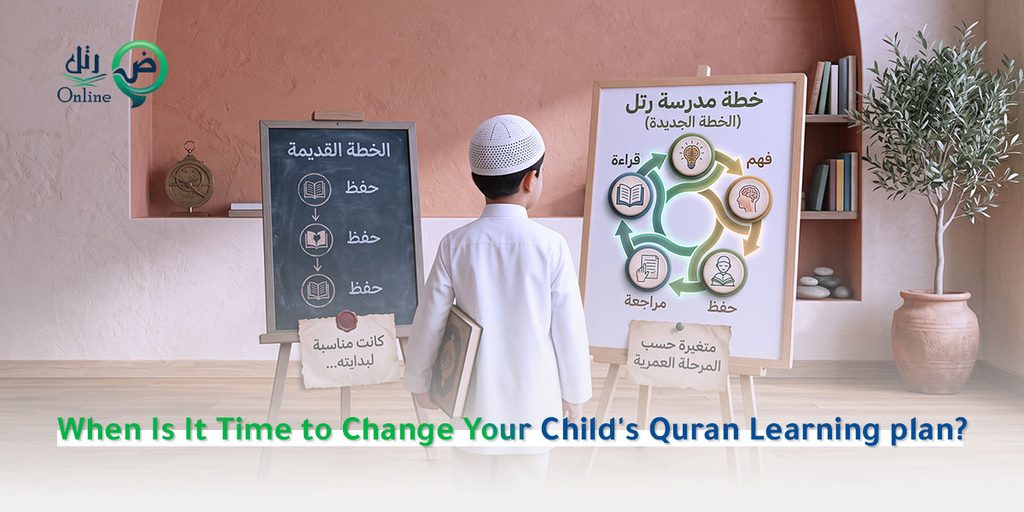
Sometimes, children don’t need more pressure or longer memorization sessions. They simply need a new learning plan that matches their current stage of development.
After all, a plan that worked perfectly for your child six months ago may no longer be the right one today.
A Quran Learning Plan Should Never Be Set in Stone when parents create a Quran memorization plan for kids, they often imagine a clear path their child should follow from beginning to end:
One Surah, then another, followed by a new Juz, and so on.
But children are constantly growing and changing.
Their reading abilities improve, their Arabic language skills develop, and their school responsibilities increase. At certain stages, they may become capable of memorizing more, while at others, they may need additional time for revision
That’s why an effective Quran learning plan shouldn’t focus only on:
“What should my child memorize this month?”
It should also ask:
“What does my child need at this stage of their learning journey?” And there’s a significant difference between these two questions.
1. When Your Child Memorizes New Surahs but Forgets Previous Ones
It’s natural to feel proud when your child completes a new Surah every few weeks.
But imagine asking them to recite a Surah they memorized several months ago, only to discover that they struggle to remember certain verses or cannot complete it without help.
Does this mean your child has a poor memory?Not necessarily.
The problem may be that their current learning plan moves faster than their ability to retain what they’ve already learned.
In this situation, the solution isn’t always to increase memorization practice.
Instead, your child may benefit from temporarily reducing the amount of new material and dedicating more time to revision.
Because the goal of Quran memorization for children isn’t simply to complete as many Surahs as possible.
It’s also about helping them remember and retain what they’ve learned.
2. When Quran Lessons Become a Daily Struggle
“I don’t want to attend my lesson today.”
“Can we do it tomorrow?”
“I’m tired.”
Hearing these words occasionally is completely normal.
However, when they become part of your child’s routine before almost every Quran lesson, it may be time to reconsider the learning plan.
Repeated resistance can be a sign that something needs to change.
Perhaps the lesson is scheduled at an inconvenient time.
Maybe the session is longer than your child’s attention span allows.
The memorization requirements might be too demanding, or your child may simply need a more interactive teaching approach.
Instead of asking:
“How can I make my child follow the plan?”
Consider asking:
“What can we change in the plan to help my child continue learning?”
Sometimes, a small adjustment can make Quran lessons feel enjoyable and manageable again.
3. When Your Child Stops Making Progress Despite Attending Regularly
Not every learning difficulty appears as resistance or a lack of motivation.
Sometimes, your child continues attending lessons and practicing regularly, yet their progress seems to have stopped.
The same pronunciation mistakes keep appearing
Certain Arabic words remain difficult to read and revision doesn’t seem to improve their recitation.
At this point, adding more lessons may not solve the problem.
Your child might need to revisit a foundational skill, such as Arabic reading, letter pronunciation, Tajweed rules, or basic language comprehension.
Taking a step back doesn’t necessarily mean falling behind, sometimes, strengthening the foundation is the most effective way to move forward.
4. When Your Child’s Abilities Improve but the Learning Plan Stays the Same
Changing a Quran learning plan isn’t always necessary because something is going wrong.
Sometimes, it’s necessary because your child is doing better.
A child who initially needed short verses and frequent repetition may eventually become capable of memorizing longer passages, understanding deeper meanings, or reviewing independently.
If the learning plan remains at the same level, the child may begin to feel bored or unchallenged.
This is when the teacher may need to gradually introduce more advanced learning goals.
Effective Quran education should neither overwhelm children nor keep them working below their abilities.
The learning plan should grow alongside the child.
5. When Your Child’s Daily Routine Changes
There’s another important factor parents sometimes overlook when creating a Quran memorization schedule for kids: Life itself.
Starting a new school year, preparing for exams, moving to another school, joining extracurricular activities, or even changing sleeping habits can affect a child’s concentration and energy.
A learning plan may still be academically appropriate, but its schedule might no longer fit the child’s daily routine.
In such cases, temporarily reducing the memorization workload doesn’t mean giving up on the goal.
In fact, maintaining a smaller but consistent learning routine may be far more beneficial than following an ambitious plan that becomes impossible to maintain.
What About Arab Children Growing Up Abroad?
For Arab families living outside Arabic-speaking countries, Quran learning plans may require even greater flexibility.
A child may begin learning the Quran with a strong understanding of Arabic, but as the years pass, the language used at school and in everyday life may become more dominant,The opposite can also happen.
A child who initially struggles with Arabic may gradually develop stronger language skills through consistent learning and practice.
This means their Quran learning plan should evolve accordingly.
At one stage, they may need more support with Arabic vocabulary and understanding Quranic words before increasing memorization.
Later, they may be ready to focus more on recitation, Tajweed, or memorizing longer passages.
The learning plan should reflect the child’s actual abilities, not simply their age or how long they’ve been attending Quran classes.
How Can You Tell It’s Time to Change Your Child’s Quran Learning Plan?
You don’t have to wait until your child completely loses interest in learning the Quran.
Instead, pay attention to their overall progress and experience.
If your child is forgetting more than they’re retaining, showing a prolonged loss of motivation, struggling with the same difficulties despite regular attendance, or finding lessons consistently too easy or too challenging, these may be signs that their learning plan needs to be reviewed.
And changing the plan doesn’t necessarily mean starting over.
Sometimes, all your child needs is:
– Less new memorization and more revision.
– A different lesson schedule.
– Additional support with Arabic.
– A more interactive teaching approach.
– A gradual transition to a more advanced level.
A small adjustment at the right time can help prevent bigger learning difficulties later.
How Does Rattiel Quran Academy Adapt to Each Child’s Learning Journey?
At Rattiel Quran Academy, we understand that every child learns differently.
That’s why we offer one-on-one online Quran classes, allowing each student to learn at a pace that matches their individual abilities and needs.
Your child doesn’t have to struggle to keep up with a group or wait for other students to reach the same level Instead, their learning journey can be adapted to their progress.
Through ongoing monitoring, teachers can identify when a child may benefit from additional revision, more Arabic language support, or adjustments to their memorization goals.
With experienced male and female teachers who understand children’s different learning needs, the focus is not on forcing every student to follow a fixed plan.
It’s about creating a learning experience that adapts to the child.
Final Thoughts: Don’t Become More Attached to the Plan Than the Goal,It’s easy to become focused on the details of a Quran learning plan.
How many Surahs has your child memorized?
How many pages have they completed?
When will they finish the next Juz? But remember that the plan is only a tool.
The real goal is to help your child learn, understand, and build a lasting connection with the Quran.
If they need to slow down, give them time.
If they need more revision, make room for it.
And if they’re ready for a greater challenge, help them move forward.
A successful Quran learning plan isn’t one that follows every detail exactly as originally written.
It’s one that continues to support your child through every stage of their learning journey.
Does your child’s current Quran learning plan no longer seem suitable for their needs?
Book a free trial lesson with Rattiel Quran Academy and let us help you identify your child’s current level and find the learning approach that best supports their Quran journey