
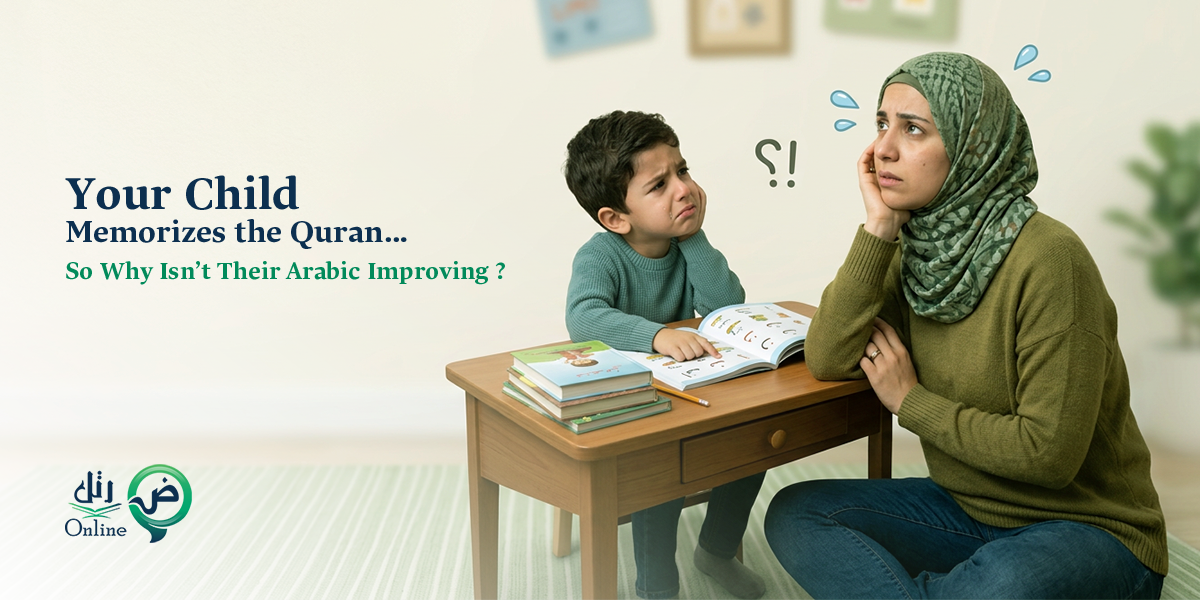
“My son has memorized all of Juz’ Amma, yet if I ask him to tell me about his day in Arabic, he replies only in English.”
This is a common saying of Arab parents living abroad.
You may have experienced this situation with your own child:
Your child memorizes the Surahs perfectly and recites the ayat beautifully, but when you try to speak with them in Arabic, they hesitate, struggle to find the right words, or automatically switch to the language they use throughout the day.
This raises a logical question:
If they have memorized the Quran, why hasn’t their Arabic gotten better?
The answer, quite simply, is that while memorizing the Quran helps strengthen Arabic, it is not enough to develop strong everyday speaking skills.
Quran Memorization Is Different from Learning Arabic
While the two may seem similar, they are, in fact, distinct.
When a child memorizes the Quran, they practice correct pronunciation, become familiar with eloquent Arabic vocabulary, and grow accustomed to the sounds and letters of the language.
However, learning Arabic goes beyond mere memorization; the language requires four fundamental elements:
Listening.
Comprehension.
Speaking.
Using the language in everyday life
That is why a child may memorize an entire Surah very well but still not understand the meaning of some of the words they recite.
This does not mean that memorization failed to provide benefit or improve their Arabic; rather, it indicates that a crucial step is still missing.
Why Does This Happen So Often with Children Living Abroad?
For children living in foreign countries, Arabic becomes a language they hear for only a few hours.
At school, they speak English, French, or German. With friends, they usually use the language spoken around them.
Even the shows and videos they watch are often in a different language; consequently, Arabic becomes for them merely the “language of the lesson” or the “language of the home,” rather than a language of everyday life.
This is where the gap emerges.
The child may be able to memorize the text, yet finds no opportunity to use the words outside of study time.
Memorization Without Understanding Keeps Arabic Limited to Recitation.
Imagine a child memorizing a word in your native language and repeating it every day without understanding its meaning or how to use it in a sentence.
Would it truly become part of their language? Probably not.
This is what happens with many children: memorization alone builds memory, but it does not build communication skills.
However, when a child understands the meaning of an ayah, connects it to a real-life situation, and uses some of its words in conversation, the language begins to grow naturally over time.
Should We Delay Quran Memorization Until a Child Learns Arabic?
The answer is no.
The child is not required to choose between the Quran and the Arabic language; rather, he should learn both together in a balanced way.
The Quran can be a powerful way to build a child’s Arabic vocabulary, especially when memorization is connected to understanding.
Every new ayah is an opportunity to acquire new words, and every new word is an opportunity to expand his vocabulary.
Over time, Arabic transforms from a subject he merely memorizes into a language he understands and uses.
How Can We Use Quran Memorization to Strengthen a Child’s Arabic?
There are simple steps that make a big difference:
Not every Quran lesson gives attention to language. Some programs focus mainly on memorization and repetition.
Others also help the child understand what they are reading and make Arabic part of their Quran learning journey.
This is especially important for children growing up abroad. They do not only need help memorizing the Quran; they also need support in building a stronger connection with Arabic.
In Rattel, we do not treat Quran learning and Arabic as two separate paths. We help them grow together.
That is why we focus on:
✔️ Explaining new vocabulary in a way that matches the child’s age.
✔️ Simplifying meanings and connecting them to the child’s everyday life.
✔️ Recognizing that Arabic may not be the first or strongest language for many children.
✔️ Using an interactive approach that encourages children to speak, ask questions, and participate instead of simply repeating.
The goal is not just for a child to memorize more ayat. It is to help them understand what they memorize, connect with it, and strengthen their Arabic step by step.
In the End…
If your child is memorizing the Quran but still struggles to speak Arabic, do not worry.
This does not mean memorization has failed. It simply means that Arabic needs more space for understanding, conversation, and everyday practice.
Quran study can become a powerful way not only to build a connection with the words of Allah, but also to strengthen your child’s Arabic in a natural and steady way.
📍 Book two free trial sessions for your child with Ratil School, and let them experience a journey that combines a love for the Quran, an understanding of its meanings, and the development of their Arabic language skills, all at once.
Subscribe now to the Ratal Online School mailing list and you will receive weekly tips and best practices to help you teach your children the Quran and Arabic language.